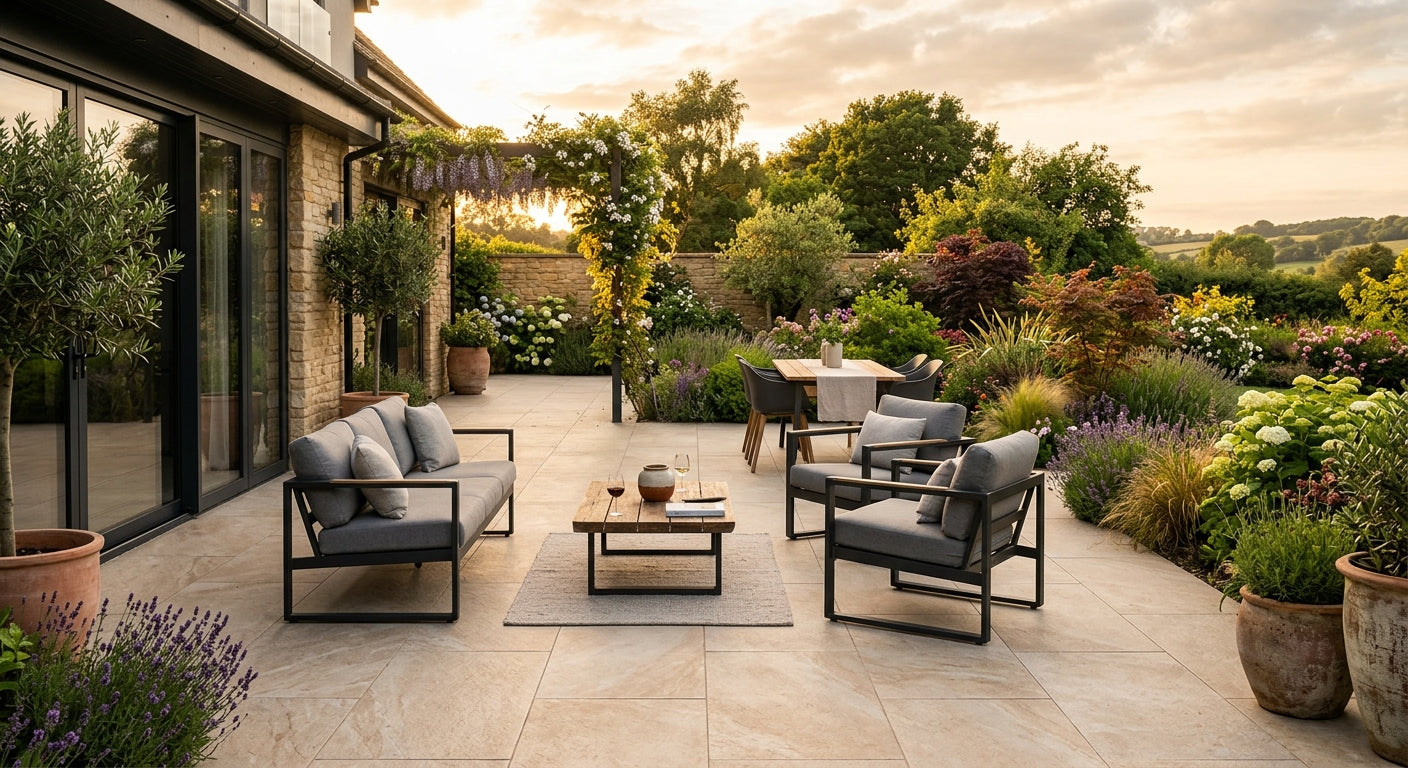
We get asked a lot of questions about bringing porcelain indoors. Most people know it as an outdoor material for patios and driveways, so it's a fair thing to wonder about. The truth is it's the exact same tile either way, which means the durability and low maintenance you'd expect outside carries straight through to a kitchen, hallway or orangery floor.
Below we've answered the questions we hear most about porcelain flooring, looked at how to get a seamless look between your indoor and outdoor space, and picked out a few of our most popular styles for the job. Explore our full range of porcelain tiles to see everything available.
Is Porcelain Flooring Good for Indoor Use?

In short, yes, and largely for the same reasons it performs so well outside. It's dense, doesn't need sealing to hold up day to day, and it's compatible with underfloor heating, which makes it a genuinely practical choice for a kitchen or living space rather than a patio material used indoors as an afterthought. Large-format porcelain tiles also mean fewer grout lines across a room, which gives an indoor floor a cleaner, more expansive look than smaller ceramic tiles typically allow.
For the full breakdown of why porcelain behaves the way it does, see our guides on why porcelain paving is perfect for outdoors and how durable porcelain paving slabs really are, and everything in both applies indoors too. If you're still deciding between materials, our guide on porcelain vs ceramic paving explains where porcelain has the edge.
Porcelain Flooring for a Seamless Indoor-Outdoor Look
One of the biggest draws of porcelain flooring is being able to run the same tile from a kitchen or living space straight out through bi-fold or French doors onto a matching patio, with no visual break between the two, a detail we go into further in add value to your property.
For a light, versatile base that suits both a kitchen and a garden, our Rasa White 600x900, Pearl Grey 600x900 and Valore Light Grey Plank 150x610 are popular choices. Browse the full white and light grey porcelain tiles collections for more inspiration, or see our guide on styling your garden with porcelain paving slabs.
Popular Porcelain Flooring Styles for Indoor-Outdoor Spaces
A few more styles worth considering if you're planning the flow between an indoor room and the garden beyond:
-
A warm, wood-look finish for hallways and kitchens that still holds up outdoors: browse our wood effect collection.
-
A softer, sandstone-look finish that pairs well with terracotta or brick interiors: see our sandstone effect collection.
-
Matching wall tiles to carry a colour or texture from the floor up a feature wall: our wall cladding range is designed for exactly this.
Not sure which finish suits your space? Order a sample of a few options and see how they look in your own light before committing.
Porcelain Flooring FAQs:
Is porcelain flooring expensive?
It can cost more upfront than budget alternatives like ceramic or laminate, but its durability and lack of ongoing maintenance often make it more cost-effective over its lifetime. Our guide on purchasing porcelain paving by the m² will help you budget accurately.
Is porcelain flooring difficult to install?
It's a job best left to an experienced installer, since porcelain needs specific tools and techniques to cut and lay correctly. Our guide on how to lay porcelain paving correctly covers what's involved.
Is porcelain flooring slippery underfoot?
No. Most of our porcelain carries an R11 anti-slip rating to current British standards, so it's safe underfoot even in wetter areas like a kitchen or boot room, despite its smooth finish.
Does porcelain flooring scratch easily?
It's highly scratch-resistant thanks to its density, though as with any floor, it's worth keeping a couple of spare tiles from your original order aside in case of accidental damage further down the line.
Can porcelain flooring be cut to fit a room?
Yes, using a diamond blade designed specifically for porcelain. This is another reason professional installation is worth it, particularly around trickier areas like doorways and fitted units.
Is porcelain flooring low maintenance?
Very. Its low porosity means dirt and moisture sit on the surface rather than soaking in, so a regular sweep and an occasional wash in warm, soapy water is normally enough. See our guide on whether cleaning changes the tile colour for more detail.
Can you seal porcelain flooring?
You can, though it isn't essential. Porcelain's low porosity already limits how much moisture or dirt it absorbs, so sealing simply adds an extra layer of protection in spill-prone spots like under a sink.
Does porcelain flooring stain?
It's naturally stain-resistant, and most spills wipe away easily if you get to them in reasonable time. Sealing can offer extra peace of mind for a particular spot you're worried about.
Do porcelain floor tiles fade over time?
They're highly fade-resistant since colour is fired into the tile rather than applied as a surface coating, though years of intense, direct sunlight by a window can cause very slight changes in appearance.
Is porcelain flooring the right choice for your home?
For most homes, yes, particularly if you want a durable, low-maintenance floor that can also extend outside. Order a sample to see the colour and finish for yourself, or contact our team if you'd like advice on the right style.
Contact Our Team for More Advice