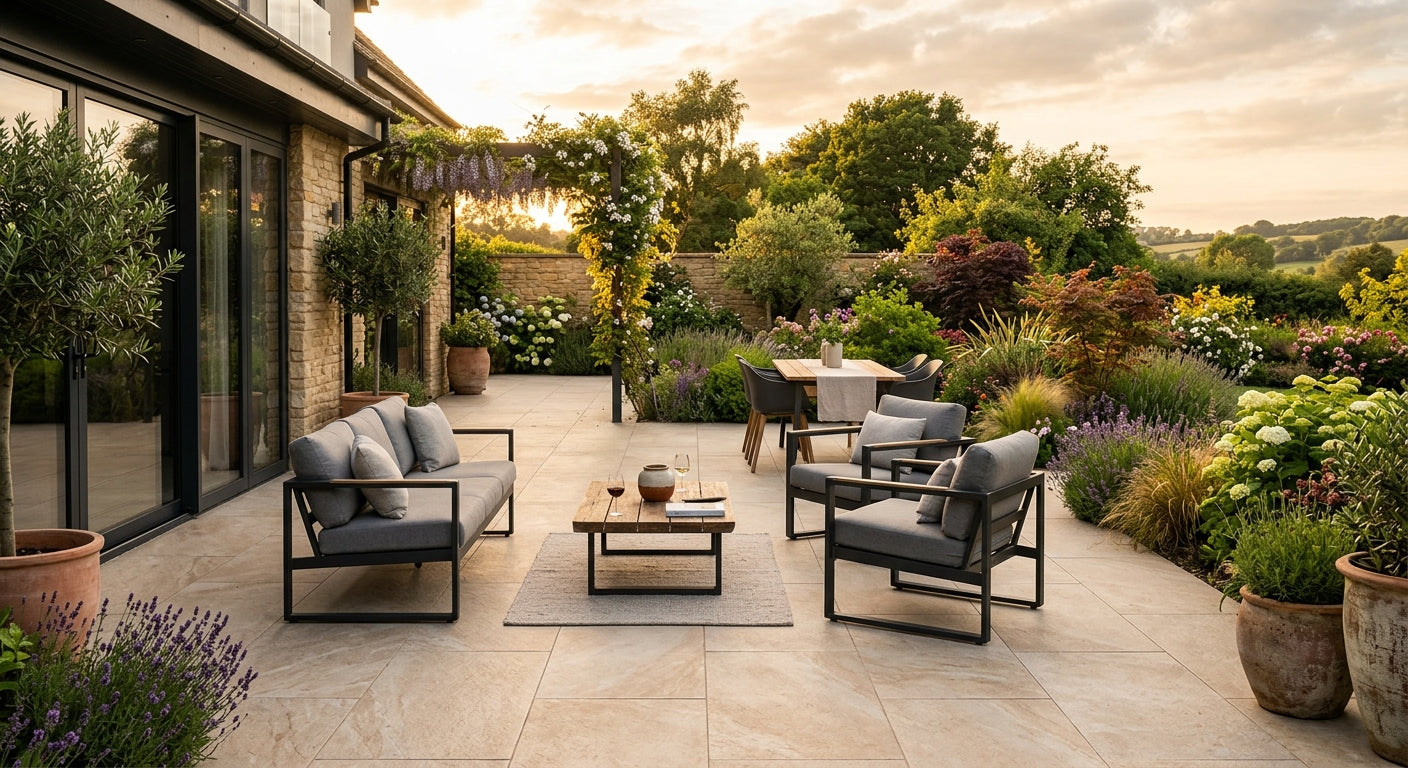
When it comes to garden landscaping ideas, there are plenty of modern designs around. However, porcelain paving tiles have the ability to effortlessly create a patio that is not only eye-catching but also practical and low maintenance.
A patio that is well-designed and installed by a professional can turn any garden into a relaxing space, one suitable to spend hours in the sunshine with friends and family relaxing or entertaining.
There are practically no limitations when it comes to porcelain paving. These heavy duty, high quality patio slabs are suitable for patios, gardens, pathways, swimming pools, balconies, verandas, a host of indoor spaces, and also as garden steps!
Why install porcelain paving outdoor steps?

A garden that is easy on the eye is great. However, a garden that boasts practicality is even more desirable, especially given our sometimes busy schedules and demanding work commitments.
Whether you wish to design steps that lead directly up to the entrance of your home or steps that trail down to lower levels in your garden, the installation of steps makes it easy for you and your guests to navigate the garden easily and safely.
If you have already installed porcelain paving for your patio, you could consider using the same tiles for your steps. Alternatively, if you haven’t yet purchased from Build Pave and are looking for a complete patio and steps makeover, we can help.
Check out our beautiful porcelain paving catalogue here.
Perhaps you would prefer a more eye-catching design? If this is the case, we would recommend using a mix of different coloured porcelain paving slabs to create a unique look that is guaranteed to stand out.
Which porcelain paving slabs should I use?
Considering which porcelain slabs to use includes looking at sizes, the different tiles you may need, and how to go about installation.
What size porcelain tiles should I use for steps?
For step treads, you want a tile with a front-to-back depth of between 300mm and 450mm, just enough to provide a comfortable, safe footing. Several sizes from our range work well for this:
- 1200x400mm — the 400mm depth sits right in the ideal range for a step tread with minimal cutting needed, making it one of the most practical choices. Check out our Ardesie and Hard ranges for options in this size.
- 600x600mm — a reliable choice for a standard tread depth, and easy to work with.
- 800x800mm — suits wider or more statement steps where you want a generous tread.
-
600x900mm — can be cut down to size and gives you flexibility on depth.
When laying the tread, make sure the tile overhangs the riser face by around 20–25mm. This creates a clean, defined edge and gives the steps a more finished, professional look.
For the riser face itself, our wall cladding tiles are a perfect fit. Available in a 610x150mm format, they are designed for vertical surfaces and pair well with our paving range to create a cohesive, polished finish.
Do I need different tiles for the tread and riser?

Not necessarily, but it is worth thinking about. The simplest approach is to use the same tile for both, cutting it down to fit the riser face, which gives a seamless, uniform look that works particularly well if you are matching your steps to an existing patio.
If you want more visual interest, using a contrasting tile for the riser is a popular design choice. Our wall cladding range works well here, as the narrower format sits naturally on a vertical face and is available in colours that complement our paving range. A lighter cladding tile against a darker paving tread can make steps stand out as a feature in their own right.
How are porcelain steps installed differently to flat paving?
The overall process is similar to laying flat paving, but there are a few important differences to keep in mind.
Each tread should be laid with a slight forward fall of around 5 to 10mm so that rainwater drains away from the step rather than pooling on the surface. On flat paving this is less critical, but on steps it directly affects both safety and longevity.
The riser face requires adhesive to bond vertically, so it is important to use a suitable porcelain and stone adhesive and apply it to both the riser surface and the back of the tile. Press firmly and check each riser is plumb before moving on to the tread above.
For the full installation process, our guides to ordering your paving, preparing the ground and laying porcelain paving cover everything you need to know before you start.